> For the complete documentation index, see [llms.txt](https://atomoh.gitbook.io/kubernetes/llms.txt). Markdown versions of documentation pages are available by appending `.md` to page URLs; this page is available as [Markdown](https://atomoh.gitbook.io/kubernetes/en/service-mesh/istio.md).
# Istio
A practical guide for utilizing Istio Service Mesh on Amazon EKS.
## Table of Contents
1. [Do You Really Need a Service Mesh?](#do-you-really-need-a-service-mesh)
2. [Installation and Initial Setup](/kubernetes/en/service-mesh/istio/01-installation.md)
3. [Basic Concepts](/kubernetes/en/service-mesh/istio/02-basic-concepts.md)
4. [Architecture](/kubernetes/en/service-mesh/istio/03-architecture.md)
5. [AWS Integration](/kubernetes/en/service-mesh/istio/04-aws-integration.md)
6. [Glossary](/kubernetes/en/service-mesh/istio/glossary.md)
7. [Traffic Management](/kubernetes/en/service-mesh/istio/traffic-management.md)
8. [Security](/kubernetes/en/service-mesh/istio/security.md)
9. [Observability](/kubernetes/en/service-mesh/istio/observability.md)
10. [Resilience](/kubernetes/en/service-mesh/istio/resilience.md)
11. [Advanced](/kubernetes/en/service-mesh/istio/advanced.md)
12. [Troubleshooting](/kubernetes/en/service-mesh/istio/common-errors.md)
13. [Best Practices](/kubernetes/en/service-mesh/istio/best-practices.md)
14. [Alternative Comparison](/kubernetes/en/service-mesh/istio/comparison.md)
## What is Istio?
Istio is an open-source service mesh platform for connecting, securing, controlling, and observing microservices. It manages communication between services in complex microservice architectures and provides traffic control, security, and observability.
### Service Mesh Concept
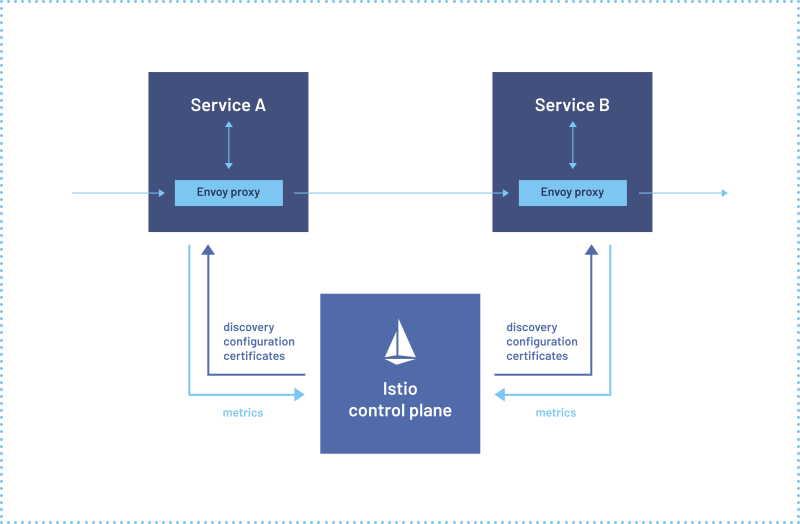
A service mesh is an infrastructure layer that manages communication between microservices. Istio deploys a Sidecar Proxy (Envoy) alongside each service to intercept and control all network traffic. This provides the following capabilities without modifying application code:
* **Traffic Routing**: Intelligent routing, load balancing, Canary deployments
* **Security**: Automatic mTLS, authentication, authorization
* **Observability**: Metrics, logs, distributed tracing
* **Resilience**: Circuit Breaking, Retry, Timeout
### Practical Usage Examples
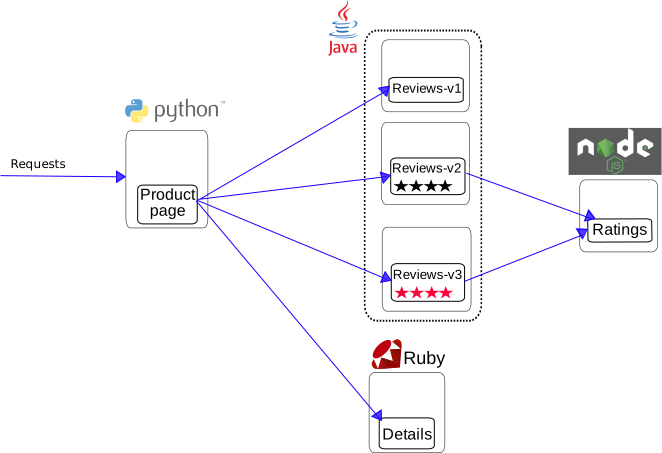
Application without Istio
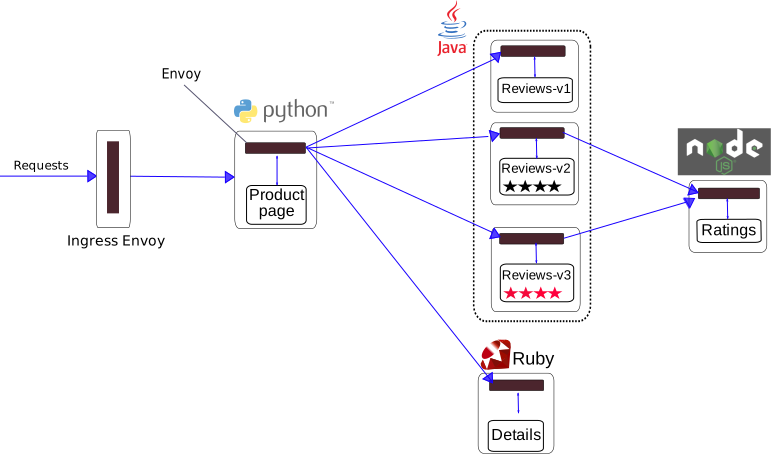
Application with Istio - Envoy Proxy deployed as Sidecar to each service
When Istio is applied, an Envoy Proxy is automatically deployed as a sidecar container to each microservice, transparently intercepting and controlling all network traffic.
## Do You Really Need a Service Mesh?
A service mesh is a powerful tool, but it's not suitable for every situation. Careful consideration is needed before adoption.
### Decision Flow
```mermaid
flowchart TD
Start[Consider Service Mesh
Adoption]
Q1{Microservices
Architecture?}
Q2{More than
10 services?}
Q3{Complex traffic
management needed?}
Q4{Zero Trust
security needed?}
Q5{Distributed tracing/
observability needed?}
Q6{Operations resources
available?}
NoNeed[Service Mesh
Not Needed]
Consider[Consider
Adoption]
NeedMesh[Service Mesh
Recommended]
Alternatives[Consider Alternatives
- Kubernetes NetworkPolicy
- Ingress Controller
- CNI plugins
- Application-level implementation]
Start --> Q1
Q1 -->|No| NoNeed
Q1 -->|Yes| Q2
Q2 -->|No| Alternatives
Q2 -->|Yes| Q3
Q3 -->|No| Q4
Q3 -->|Yes| Q6
Q4 -->|No| Q5
Q4 -->|Yes| Q6
Q5 -->|No| Consider
Q5 -->|Yes| Q6
Q6 -->|No| Consider
Q6 -->|Yes| NeedMesh
%% Style definitions
classDef question fill:#F8B52A,stroke:#333,stroke-width:2px,color:black;
classDef no fill:#E6522C,stroke:#333,stroke-width:2px,color:white;
classDef maybe fill:#326CE5,stroke:#333,stroke-width:2px,color:white;
classDef yes fill:#00C7B7,stroke:#333,stroke-width:2px,color:white;
classDef alternative fill:#f9f9f9,stroke:#333,stroke-width:1px,color:black;
%% Apply classes
class Q1,Q2,Q3,Q4,Q5,Q6 question;
class NoNeed no;
class Consider maybe;
class NeedMesh yes;
class Alternatives alternative;
```
### When Service Mesh is Needed ✅
#### 1. Complex Microservices Environment
```mermaid
flowchart LR
subgraph WithoutMesh["Without Service Mesh"]
A1[Service A] -.->|Manual implementation| B1[Service B]
A1 -.->|Manual implementation| C1[Service C]
B1 -.->|Manual implementation| D1[Service D]
C1 -.->|Manual implementation| D1
Note1[For each service
- Manual mTLS implementation
- Retry logic
- Logging/metrics
- Circuit Breaker
Increased duplicate code]
end
subgraph WithMesh["With Service Mesh"]
A2[Service A] -->|Automatic handling| B2[Service B]
A2 -->|Automatic handling| C2[Service C]
B2 -->|Automatic handling| D2[Service D]
C2 -->|Automatic handling| D2
SM[Service Mesh
- Automatic mTLS
- Centralized policies
- Unified observability
- Standardized security]
SM -.->|Control| A2
SM -.->|Control| B2
SM -.->|Control| C2
SM -.->|Control| D2
end
%% Style definitions
classDef service fill:#00C7B7,stroke:#333,stroke-width:1px,color:white;
classDef mesh fill:#326CE5,stroke:#333,stroke-width:2px,color:white;
classDef note fill:#f9f9f9,stroke:#333,stroke-width:1px,color:black;
%% Apply classes
class A1,B1,C1,D1,A2,B2,C2,D2 service;
class SM mesh;
class Note1 note;
```
**Recommended Criteria**:
* ✅ 10 or more microservices
* ✅ Frequent inter-service communication (East-West traffic)
* ✅ Multiple programming languages used (Polyglot)
* ✅ Multiple teams developing services independently
#### 2. Zero Trust Security Requirements
**Service Mesh Provides**:
* Automatic mTLS encryption between services
* SPIFFE-based Identity management
* Fine-grained authentication/authorization policies
* Guaranteed encrypted communication
**Difficult to Achieve Without Alternatives**:
* Duplicate security logic implementation in each service
* Complexity of manual certificate management
* Inconsistent security policies
#### 3. Advanced Traffic Management
```yaml
# Canary Deployment (Traffic Distribution)
apiVersion: networking.istio.io/v1
kind: VirtualService
metadata:
name: reviews
spec:
hosts:
- reviews
http:
- route:
- destination:
host: reviews
subset: v1
weight: 90
- destination:
host: reviews
subset: v2
weight: 10 # Only 10% to new version
```
**When Needed**:
* Canary deployments, A/B testing
* Header/path-based routing
* Traffic Mirroring (Shadow Testing)
* Fault Injection (Chaos Engineering)
* Circuit Breaking, Retry, Timeout
#### 4. Unified Observability
**Service Mesh Advantages**:
* Automatic metric collection without application code modification
* Automatic Distributed Tracing implementation
* Unified logging format
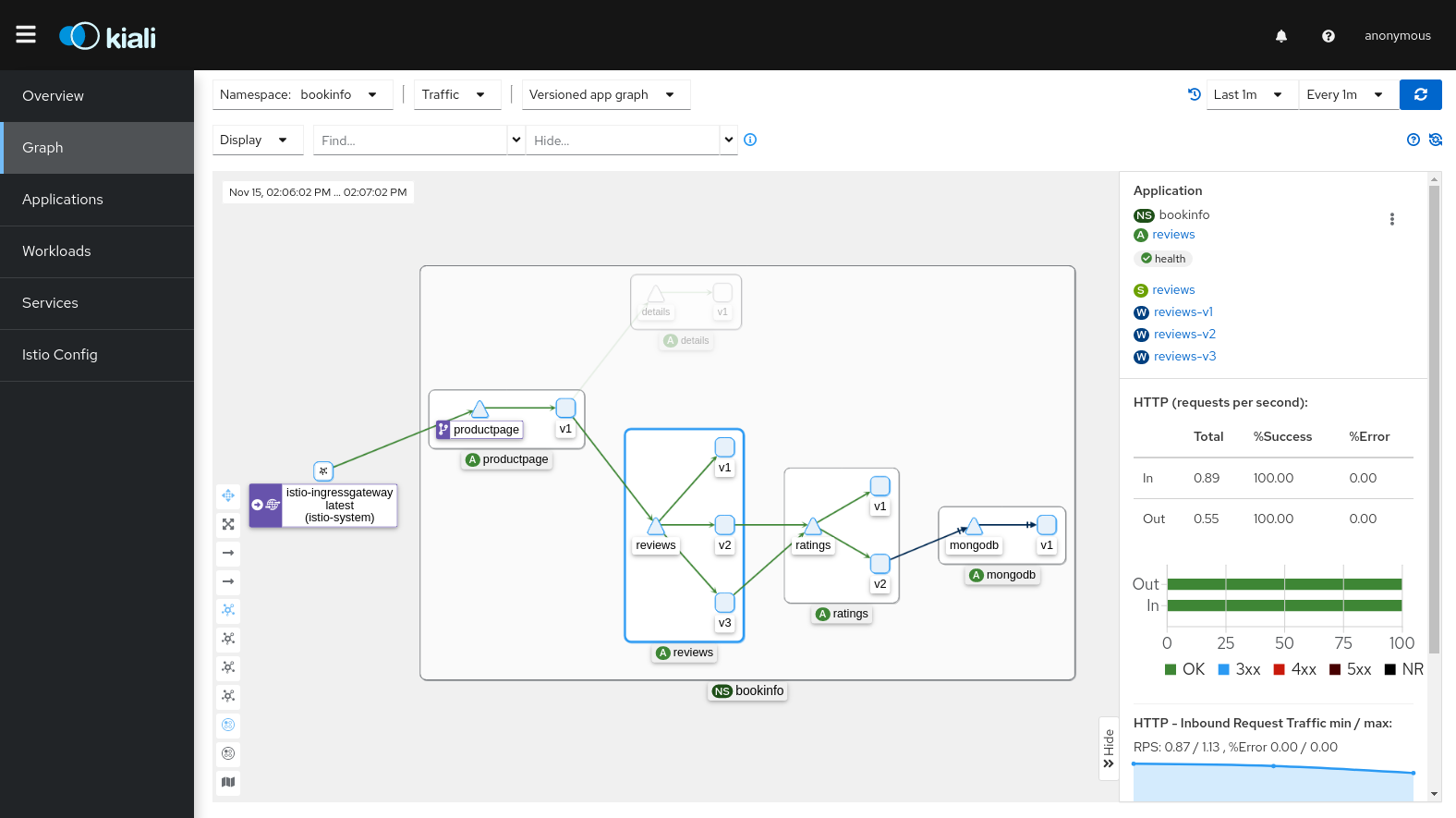
* Service topology visualization (Kiali)
### When Service Mesh is Not Needed ❌
#### 1. Simple Architecture
```mermaid
flowchart LR
User[User] --> LB[Load Balancer]
LB --> App[Monolithic
Application]
App --> DB[(Database)]
Note["Service Mesh Not Needed
- Single application
- Simple communication patterns
- Ingress is sufficient"]
%% Style definitions
classDef simple fill:#00C7B7,stroke:#333,stroke-width:1px,color:white;
classDef note fill:#f9f9f9,stroke:#333,stroke-width:1px,color:black;
%% Apply classes
class User,LB,App,DB simple;
class Note note;
```
**Use Instead**:
* Kubernetes Ingress Controller (NGINX, Traefik)
* Simple load balancer
* Application-level implementation
#### 2. Few Microservices (<10)
**Overhead is Greater**:
* Service Mesh operational complexity > benefits gained
* 5-10 services can be managed manually
* NetworkPolicy provides sufficient security
**Alternative**:
```yaml
# Kubernetes NetworkPolicy is sufficient
apiVersion: networking.k8s.io/v1
kind: NetworkPolicy
metadata:
name: allow-frontend-to-backend
spec:
podSelector:
matchLabels:
app: backend
ingress:
- from:
- podSelector:
matchLabels:
app: frontend
```
#### 3. Insufficient Operations Resources
**Service Mesh Operations Requirements**:
* Istio/Envoy expertise
* Control Plane monitoring and management
* Upgrade and patch management
* Troubleshooting capability (increased debugging complexity)
**Team Preparation Needed**:
* At least 1-2 Service Mesh experts
* Continuous learning and update tracking
* Sufficient test environment
#### 4. When Performance is Extremely Critical
**Service Mesh Overhead**:
* Latency: +1-3ms (P50), +5-10ms (P99)
* CPU: +10-20% per pod
* Memory: +50-100MB per pod (Sidecar mode)
**Consider Alternatives**:
* Ambient Mode (90% reduction in resource usage)
* CNI-based solutions (Cilium)
* Application-level optimization
### Alternative Solutions Comparison
| Feature | Service Mesh | CNI (Cilium) | Ingress Controller | App-level |
| -------------------------- | -------------------------------------------- | --------------- | ------------------ | ------------------------ |
| **L7 Traffic Management** | ✅ Full support | ⚠️ Limited | ⚠️ Ingress only | ✅ Possible |
| **mTLS Automation** | ✅ Full support | ✅ Possible | ❌ Not supported | ❌ Manual implementation |
| **Distributed Tracing** | ✅ Automatic | ❌ Not supported | ❌ Not supported | ⚠️ Manual implementation |
| **L3/L4 Policies** | ✅ Supported | ✅ Full support | ❌ Not supported | ❌ Not supported |
| **Operational Complexity** | 🔴 High | 🟡 Medium | 🟢 Low | 🟡 Medium |
| **Resource Overhead** | 🔴 High (Sidecar)
🟢 Low (Ambient)
| 🟢 Low | 🟢 Low | 🟢 None |
| **Suitable Scale** | 10+ services | All scales | Small scale | Small scale |
### CNI-Based Solution (Cilium)
Cilium provides many features at the **network level** based on eBPF:
```mermaid
flowchart TB
subgraph Comparison["Feature Comparison"]
subgraph ServiceMesh["Service Mesh (Istio)"]
SM1[L7 Proxy-based
Envoy Sidecar]
SM2[Application-level
Traffic Control]
SM3[Rich L7 Features
Retry, Timeout, etc.]
end
subgraph CNI["CNI (Cilium)"]
CN1[eBPF-based
Kernel Level]
CN2[Network-level
Policy Enforcement]
CN3[High Performance
Low Overhead]
end
subgraph UseCases["Usage Scenarios"]
UC1[Service Mesh:
Complex L7 Logic]
UC2[Cilium:
Network Policy, Performance]
UC3[Both:
Large-scale Enterprise]
end
end
%% Style definitions
classDef mesh fill:#326CE5,stroke:#333,stroke-width:2px,color:white;
classDef cni fill:#F8B52A,stroke:#333,stroke-width:2px,color:black;
classDef usecase fill:#00C7B7,stroke:#333,stroke-width:1px,color:white;
%% Apply classes
class SM1,SM2,SM3 mesh;
class CN1,CN2,CN3 cni;
class UC1,UC2,UC3 usecase;
```
**When Cilium is More Suitable**:
* L3/L4 network policies are the main purpose
* High performance is a core requirement
* Avoiding Service Mesh operational burden
* Only simple mTLS and observability needed
**Reference**: [Cilium Documentation](/kubernetes/en/networking/cilium.md)
### Decision Checklist
Answer the following questions before adoption:
**Architecture**:
* [ ] Do you have 10 or more microservices?
* [ ] Is inter-service communication complex?
* [ ] Are multiple programming languages used?
**Security**:
* [ ] Is a Zero Trust security model needed?
* [ ] Is mTLS encryption between services mandatory?
* [ ] Is fine-grained access control needed?
**Traffic Management**:
* [ ] Are Canary deployments, A/B testing needed?
* [ ] Are advanced routing rules needed?
* [ ] Are Circuit Breaking, Retry needed for many services?
**Observability**:
* [ ] Is distributed tracing mandatory?
* [ ] Is unified metric collection needed?
* [ ] Is service topology visualization needed?
**Operations**:
* [ ] Do you have Service Mesh experts?
* [ ] Can you handle the operational complexity?
* [ ] Can you accept the resource overhead?
**Results**:
* ✅ 10 or more checked: Service Mesh strongly recommended
* 🟡 5-9 checked: Careful evaluation needed, start small (Ambient Mode recommended)
* ❌ 4 or fewer checked: Consider alternative solutions (CNI, Ingress, App-level)
### Gradual Adoption Strategy
If you determine that a Service Mesh is needed, adopt it gradually:
```mermaid
flowchart LR
Phase1[Phase 1
Observability
Metric collection only]
Phase2[Phase 2
Security
Apply mTLS]
Phase3[Phase 3
Traffic Management
Canary Deployment]
Phase4[Phase 4
Advanced Features
Utilize all features]
Phase1 -->|After validation| Phase2
Phase2 -->|After validation| Phase3
Phase3 -->|After validation| Phase4
%% Style definitions
classDef phase fill:#326CE5,stroke:#333,stroke-width:2px,color:white;
%% Apply classes
class Phase1,Phase2,Phase3,Phase4 phase;
```
**Recommended Order**:
1. **Pilot Project** (1-2 namespaces)
2. **Observability First** (metrics, logs, traces)
3. **Apply Security** (mTLS PERMISSIVE → STRICT)
4. **Traffic Management** (VirtualService, DestinationRule)
5. **Company-wide Expansion**
### Key Features
1. **Traffic Management**
* Intelligent routing and load balancing
* A/B testing, Canary deployment, Blue/Green deployment
* Circuit Breaking, Retry, Timeout control
* Traffic Mirroring and Fault Injection
2. **Security**
* Automatic mTLS encryption between services
* Strong authentication and authorization
* Fine-grained access control policies
* Network isolation and security policies
3. **Observability**
* Automatic metrics, logs, and trace generation
* Prometheus, Grafana, Jaeger, Kiali integration
* Service topology visualization
* Real-time traffic monitoring
4. **Resilience**
* Circuit Breaker pattern
* Rate Limiting
* Outlier Detection
* Zone Aware Routing
### Istio Architecture
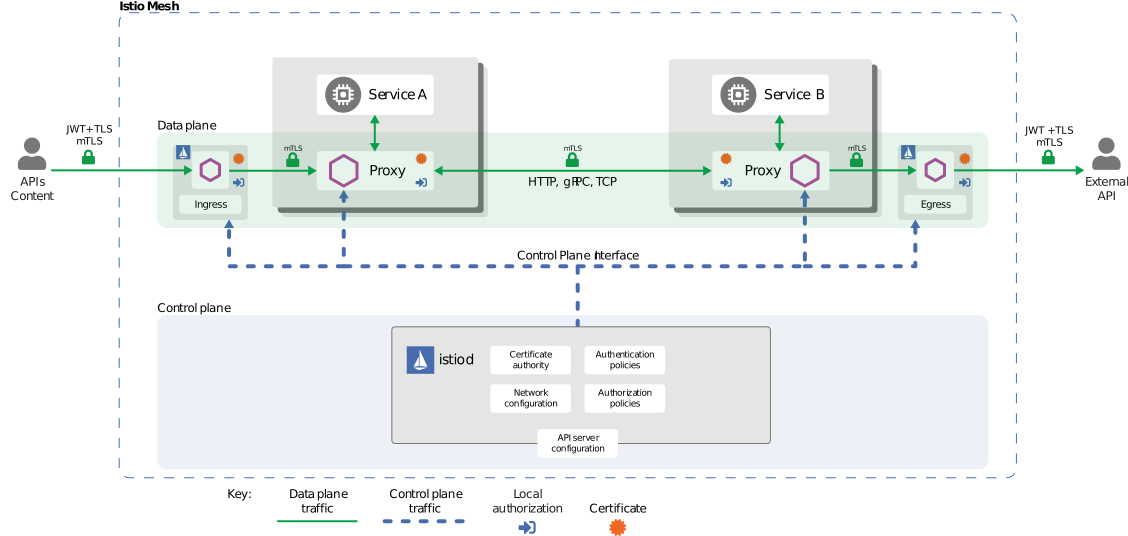
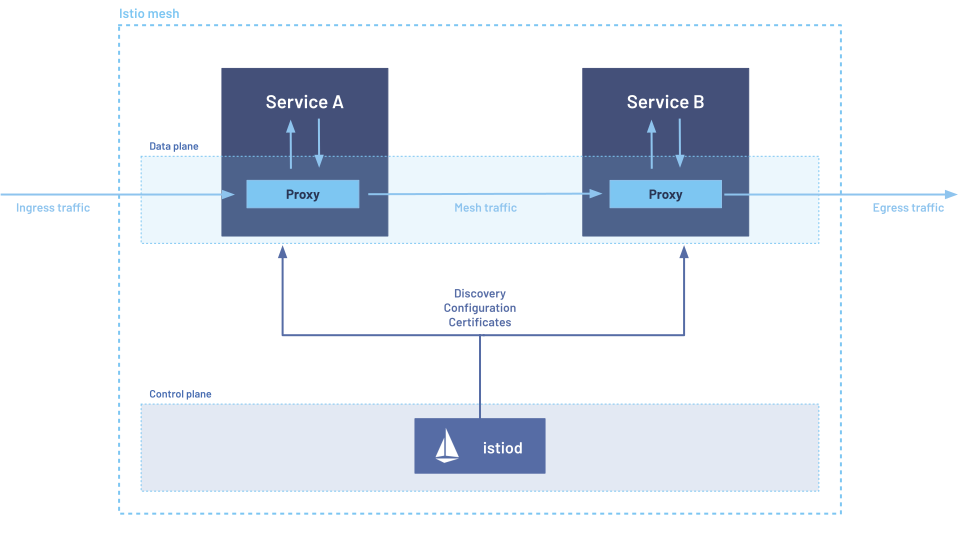
Istio consists of a Control Plane and a Data Plane:
```mermaid
flowchart TB
subgraph ControlPlane["Control Plane (istiod)"]
Pilot[Pilot
Service Discovery & Traffic Management]
Citadel[Citadel
Certificate Management & Security]
Galley[Galley
Configuration Management]
end
subgraph DataPlane["Data Plane"]
subgraph Pod1["Pod 1"]
App1[Application]
Envoy1[Envoy Proxy]
end
subgraph Pod2["Pod 2"]
App2[Application]
Envoy2[Envoy Proxy]
end
subgraph Pod3["Pod 3"]
App3[Application]
Envoy3[Envoy Proxy]
end
end
Pilot -.->|Configuration delivery| Envoy1
Pilot -.->|Configuration delivery| Envoy2
Pilot -.->|Configuration delivery| Envoy3
Citadel -.->|Certificate issuance| Envoy1
Citadel -.->|Certificate issuance| Envoy2
Citadel -.->|Certificate issuance| Envoy3
Envoy1 <-->|mTLS| Envoy2
Envoy2 <-->|mTLS| Envoy3
Envoy1 <-->|mTLS| Envoy3
App1 -->|Request| Envoy1
App2 -->|Request| Envoy2
App3 -->|Request| Envoy3
%% Style definitions
classDef controlPlane fill:#FF9900,stroke:#333,stroke-width:1px,color:black;
classDef dataPlane fill:#326CE5,stroke:#333,stroke-width:1px,color:white;
classDef app fill:#00C7B7,stroke:#333,stroke-width:1px,color:white;
classDef proxy fill:#3B48CC,stroke:#333,stroke-width:1px,color:white;
classDef default fill:#f9f9f9,stroke:#333,stroke-width:1px,color:black;
%% Apply classes
class Pilot,Citadel,Galley controlPlane;
class App1,App2,App3 app;
class Envoy1,Envoy2,Envoy3 proxy;
```
**Control Plane (istiod)**:
* **Pilot**: Service discovery, traffic routing rule management
* **Citadel**: Certificate generation and management, mTLS enablement
* **Galley**: Configuration validation and deployment
**Data Plane**:
* **Envoy Proxy**: Deployed as a sidecar to each pod, intercepting and controlling all network traffic
### Benefits of Using Istio on Amazon EKS
1. **Easy Microservices Management**
* Traffic management without application code modification
* Consistent policy application with declarative configuration
* Uses Kubernetes Native API
2. **Enhanced Security**
* Automatic encryption between services
* Authentication integrated with AWS IAM
* Fine-grained permission control
3. **Improved Observability**
* Integration with Amazon CloudWatch
* Distributed tracing through AWS X-Ray
* Detailed metrics and logs
4. **Integration with AWS Services**
* Application Load Balancer (ALB) integration
* AWS Certificate Manager (ACM) integration
* Compatible with Amazon EBS CSI Driver
### Getting Started
If you're new to Istio, read the documents in the following order:
1. [**Installation and Initial Setup**](/kubernetes/en/service-mesh/istio/01-installation.md): Install Istio on EKS cluster
2. [**Basic Concepts**](/kubernetes/en/service-mesh/istio/02-basic-concepts.md): Understand Istio core concepts
3. [**Traffic Management**](/kubernetes/en/service-mesh/istio/traffic-management.md): Learn Gateway, VirtualService, DestinationRule
4. [**Security**](/kubernetes/en/service-mesh/istio/security.md): Configure mTLS, authentication, authorization
5. [**Observability**](/kubernetes/en/service-mesh/istio/observability.md): Collect metrics, logs, traces
6. [**Best Practices**](/kubernetes/en/service-mesh/istio/best-practices.md): Recommendations for production environments
### Hands-on Examples
Each section includes working YAML examples. All examples are structured to be click-to-copy:
```yaml
# Example VirtualService
apiVersion: networking.istio.io/v1
kind: VirtualService
metadata:
name: reviews
spec:
hosts:
- reviews
http:
- route:
- destination:
host: reviews
subset: v1
```
### References
* [Istio Official Documentation](https://istio.io/latest/docs/)
* [Istio GitHub](https://github.com/istio/istio)
* [AWS EKS Workshop - Istio](https://www.eksworkshop.com/intermediate/330_servicemesh_using_istio/)
* [Istio Community](https://discuss.istio.io/)
### Quizzes
To test what you've learned in this chapter, try the following quizzes:
* [Traffic Management Quiz](/kubernetes/en/quiz-collection/service-mesh/istio/traffic-management.md)
* [Security Quiz](/kubernetes/en/quiz-collection/service-mesh/istio/security.md)
* [Observability Quiz](/kubernetes/en/quiz-collection/service-mesh/istio/observability.md)
* [Resilience Quiz](/kubernetes/en/quiz-collection/service-mesh/istio/resilience.md)
* [Advanced Quiz](/kubernetes/en/quiz-collection/service-mesh/istio/advanced.md)